


Choke vs. Inductor: What's the Difference?
 Nov 12, 2026|
 View:4
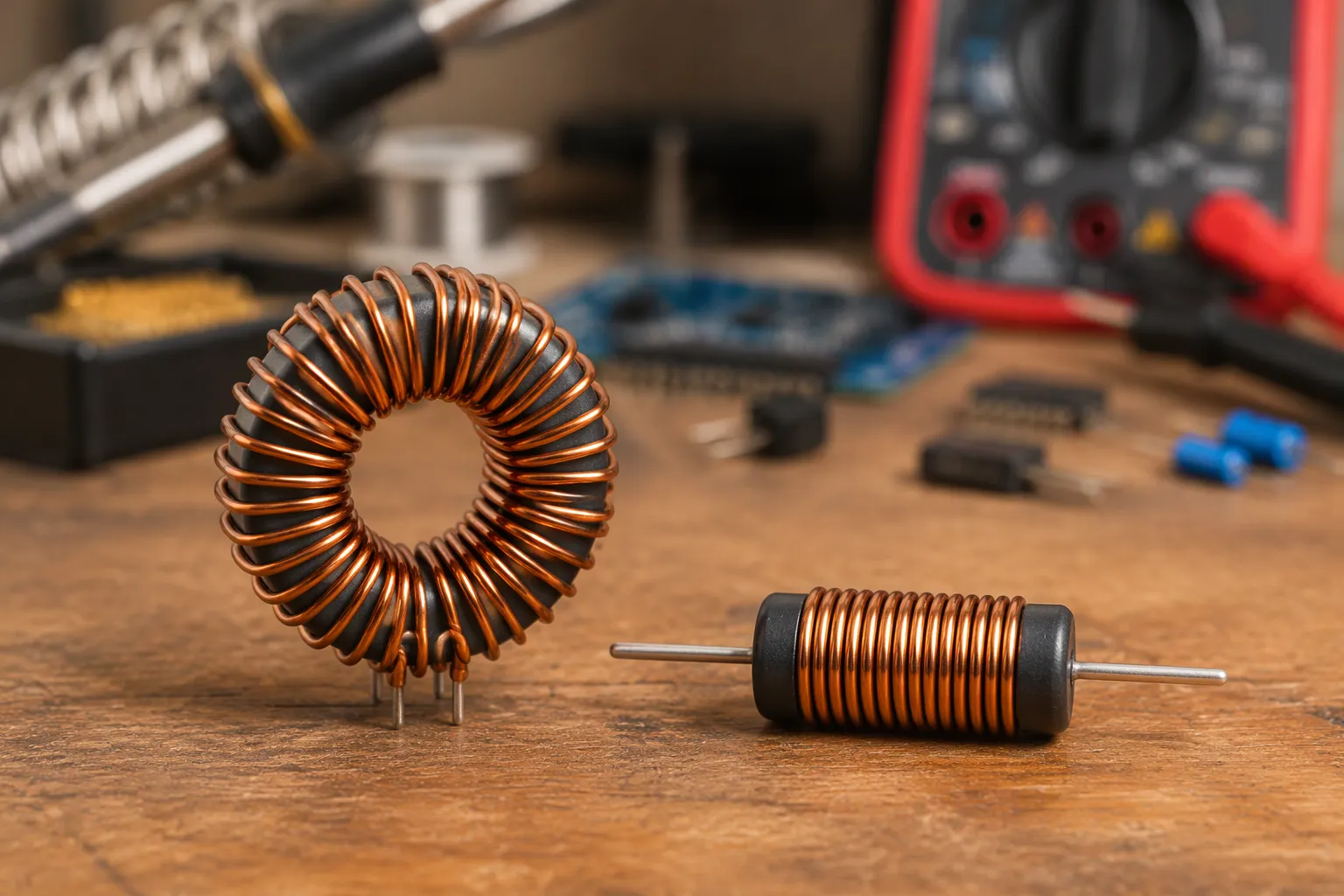
A choke is a special kind of inductor made to block high-frequency AC while letting DC or low-frequency AC through. An inductor is the larger group of parts: it stores energy in a magnetic field and resists changes in current.
Here's the simple rule: all chokes are inductors, but not all inductors are chokes. People often use choke, reactor, and coil to mean the same thing in casual talk. That habit can put the wrong part on your board. The choke vs. inductor question is really about purpose, so compare definitions, construction, and uses before you pick a part. Both parts have a place in a good design.
Key Takeaways
A choke is a special kind of inductor. It blocks high-frequency noise and lets DC flow through.
An inductor stores energy in a magnetic field and resists changes in current.
Pick a standard inductor for storing energy or shaping signals.
Pick a choke to block noise while letting DC or low-frequency signals pass through.
Pick the part that fits the job, and check specs like impedance and current rating.
What Is an Inductor?
Definition and Energy-Storage Function
So what is an inductor? It's a passive part that adds inductance (L) to a circuit. It stores energy in a magnetic field and resists sudden changes in current. You'll find this part in almost every power supply and filter you open.
Think of it as a flywheel for current. When current rises, the inductor takes in energy and slows the rise. When current falls, it gives that energy back and keeps the flow going. This action comes from inductance, which depends on the number of turns, the core material, and the shape of the winding. A higher inductance value means a stronger push against current change.
Basic Construction and Core Types
At its heart, an inductor is a coil of wire, often wound around a core. The core may be magnetic or missing entirely. The core choice shapes how the part acts at different frequencies.
Here are the common types you'll meet:
Air-core: no magnetic material, so it stays steady at high frequencies but gives lower inductance for a given size.
Ferrite core: a ferrite core boosts inductance and works well for filtering and power, though it can saturate under heavy current.
Drum core: a wire wound on a drum-shaped core, common in small power designs.
Toroidal: the winding wraps around a ring core, which holds the magnetic field tightly and cuts stray interference.
Each type trades off size, cost, saturation behavior, and frequency response. You pick the one that fits your circuit's job.
What Is a Choke?
Definition and Noise-Filtering Function
So what is a choke? It's a special kind of inductor, with or without a ferromagnetic core, that you pick mainly to stop unwanted current. It blocks high-frequency AC while it lets DC or low-frequency signals pass. That one job shapes everything about the part.
Here's the key point: the choke label describes a job, not a separate device family. When you use an inductor for signal filtering, you call it a choke. The physics stays the same. The part still stores energy in a magnetic field. You just pick it for its ability to hold back noise instead of for energy storage.
This is why filter chokes show up wherever clean power matters. A switching supply throws out high-frequency ripple. A choke sits in the path and chokes off that ripple. The DC you want still flows through. The noise you don't want gets blocked.
Construction for High-Frequency Blocking
Engineers build chokes to fight noise at specific frequencies. Core material is the first lever. A ferrite core gives high permeability and strong impedance at high frequencies, so it suits noise suppression well. Powdered iron or air cores may fit other frequency ranges.
Winding style matters too. Designers often split windings or use sectional bobbing to lower stray capacitance. Lower capacitance keeps the choke effective higher up the frequency band. A tight, single-layer winding can also reduce parasitic effects.
You'll also see chokes built as common mode types, where two windings share one core. These block noise that appears on both lines at once. The construction follows the job, and the job is always the same: pass what you need, stop what you don't.
Choke vs. Inductor: Main Differences
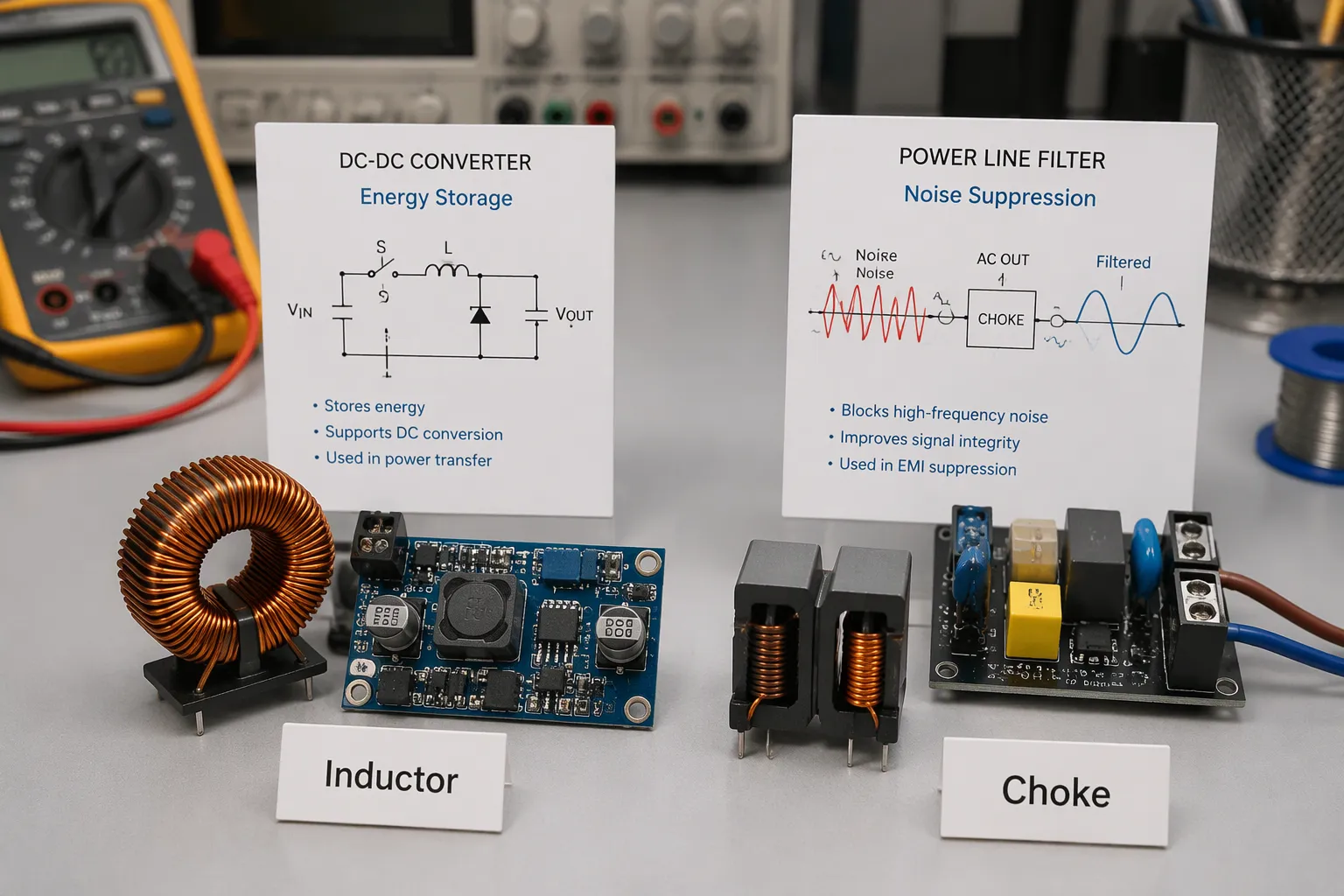
Main Differences Between Inductors and Chokes
The main differences between inductors and chokes come down to what they are meant to do. An inductor stores energy in a magnetic field and resists changes in current. A choke is picked to block high-frequency AC while letting DC pass. That is the key difference, and it shapes every design choice that follows.
Think about what each part does in a real circuit. A power inductor in a DC-DC converter holds energy between switching cycles. It gives that energy back to keep the output steady. A choke in a power line filter does the opposite job. It lets the DC you want flow through and blocks the high-frequency noise you don't want.
Construction follows function. Inductor design often favors high inductance and low resistance for storing energy. Choke design favors high impedance at noise frequencies, so core material and winding style get tuned for that band. You'll see ferrite cores and split windings on chokes, while power inductors may use drum or toroidal cores.
Here's the overlap you can't ignore: every choke is an inductor. The physics never changes. The difference between chokes and inductors is about purpose and optimization, not basic physics. You pick the part for the job, and the label follows.
Side-by-Side Comparison
The table below shows the key differences at a glance.
Feature | Inductor | Choke |
|---|---|---|
Primary function | Stores energy in a magnetic field; opposes current change | Blocks high-frequency AC; passes DC or low-frequency signals |
Design focus | Inductance value, current rating, low resistance | Impedance at noise frequencies, low stray capacitance |
Typical construction | Air-core, ferrite, drum core, toroidal | Ferrite core, split or sectional windings, common mode types |
Typical applications | DC-DC converters, power supplies, tuning circuits | EMI suppression, power-line filtering, RF blocking |
The differences between chokes and inductors show up most clearly in the design focus row. An inductor's inductance value drives how much energy it stores. A choke's impedance at a target frequency drives how well it blocks noise. Same part family, different target.
You might wonder which label fits a given part. Ask what the part must do. If it stores energy or tunes a signal, call it an inductor. If it blocks noise while passing DC, call it a choke. The chokes vs. inductors question answers itself once you name the job.
The core differences between chokes and inductors are really differences in intent. Both parts share the same physics. Both store energy in a magnetic field. The choke just gets optimized to stop high-frequency AC, and that optimization is what separates the two in practice. Keep this choke vs. inductor distinction in mind, and you'll pick the right part every time.
Inductors, Coils, and Chokes: A Terminology Note
When the Terms Overlap
People swap the words choke, reactor, and inductor all the time. In a casual chat, that's fine. On a datasheet or a purchase order, it can cost you. Each word carries a hint about the part's job, and that hint matters when you compare options.
You may hear someone ask what is a reactor. In practice, a reactor is a heavy-duty inductor built for power systems, often to limit fault current or smooth flow on a line. So what is a reactor compared to a choke? Both block unwanted current, but a reactor usually handles bigger power and a choke usually targets noise. The labels overlap, yet they point to different design goals.
Common Misuse to Avoid
Here's the clean way to sort inductors, coils, and chokes. A coil is the physical winding itself, just wire wrapped in loops. An inductor and a choke describe what that winding does in a circuit. One names the part's function, the other names its intent to block noise.
So calling a bare winding a "choke" before you know its job gets the order wrong. The same goes for treating every inductor as a filter part. Match the word to the role, and your spec sheet stays honest. Get the terms right, and you'll avoid a wrong part and a wasted build.
Common Applications for Inductors
Energy Storage and Power Conversion
You'll see regular inductors doing their best work wherever a circuit needs to store and release energy. A DC-DC converter is the classic example. The inductor takes in energy during one switching phase and gives that energy to the output during the next. Power supplies use the same method to smooth current and keep voltage steady when loads change.
This is where a plain inductor does better than a filter part. Your design goal here is high inductance and low resistance, so the part stores plenty of energy and loses little as heat. Drum core and toroidal types fit well because they pack good inductance into a small space. Pick the part for its storage job, and it will do that job reliably.
Tuning, Filtering, and Signal Processing
Inductors also do great work in signal tasks. A tuned circuit pairs an inductor with a capacitor to pick one frequency band and reject the rest. Radio front ends, oscillators, and matching networks all depend on this behavior. Filter designs use inductors to shape a response curve, letting wanted signals through while cutting off the unwanted ones.
In a real power system, inductors, chokes, reactors, and filters often sit side by side, and each one plays its own role. The inductor stores energy or tunes a signal. The choke blocks noise. The reactor handles heavy line current. The filter combines parts into one clean block. None of them replaces the others, and a good design uses each where it fits best. That is the inductor's home turf: energy storage and signal shaping, done with precision.
Common Applications for Chokes
EMI Suppression and Power-Line Filtering
You'll find chokes wherever a circuit needs clean power. A switching supply throws out high-frequency noise, and that noise can travel down the power line and upset other parts. A filter choke sits in that path and blocks high-frequency noise while the DC you want flows through. This is noise suppression at its most practical.
Common mode chokes handle a special case. Noise often appears on both power lines at the same time, and that is what we call common-mode noise. A common-mode choke uses dual windings + ferrite core construction to catch this shared noise. The two windings share one core, so the wanted current cancels out and the noise gets blocked. You'll see common-mode chokes in power supplies, LED drivers, and industrial control gear for exactly this reason.
RF and High-Frequency Blocking Circuits
Radio circuits need a part that stops high-frequency signals from leaking where they don't belong. A series choke fits that job well. It sits in line with a DC feed and holds back the RF while the DC bias passes through. You'll spot this trick in amplifier bias lines and antenna feeds.
DC chokes play a similar role in power feeds. They carry the direct current and impede the ripple riding on top of it. Filter chokes in RF stages do the same work at higher frequencies. The pattern holds across all of them: pass the low-frequency or DC content, impede the high-frequency content. That is why chokes fit these roles so well. A standard inductor stores energy or tunes a signal, and it does that job with precision. A choke simply takes on the blocking job, and it does that one thing reliably.
How to Choose Between Chokes vs. Inductors
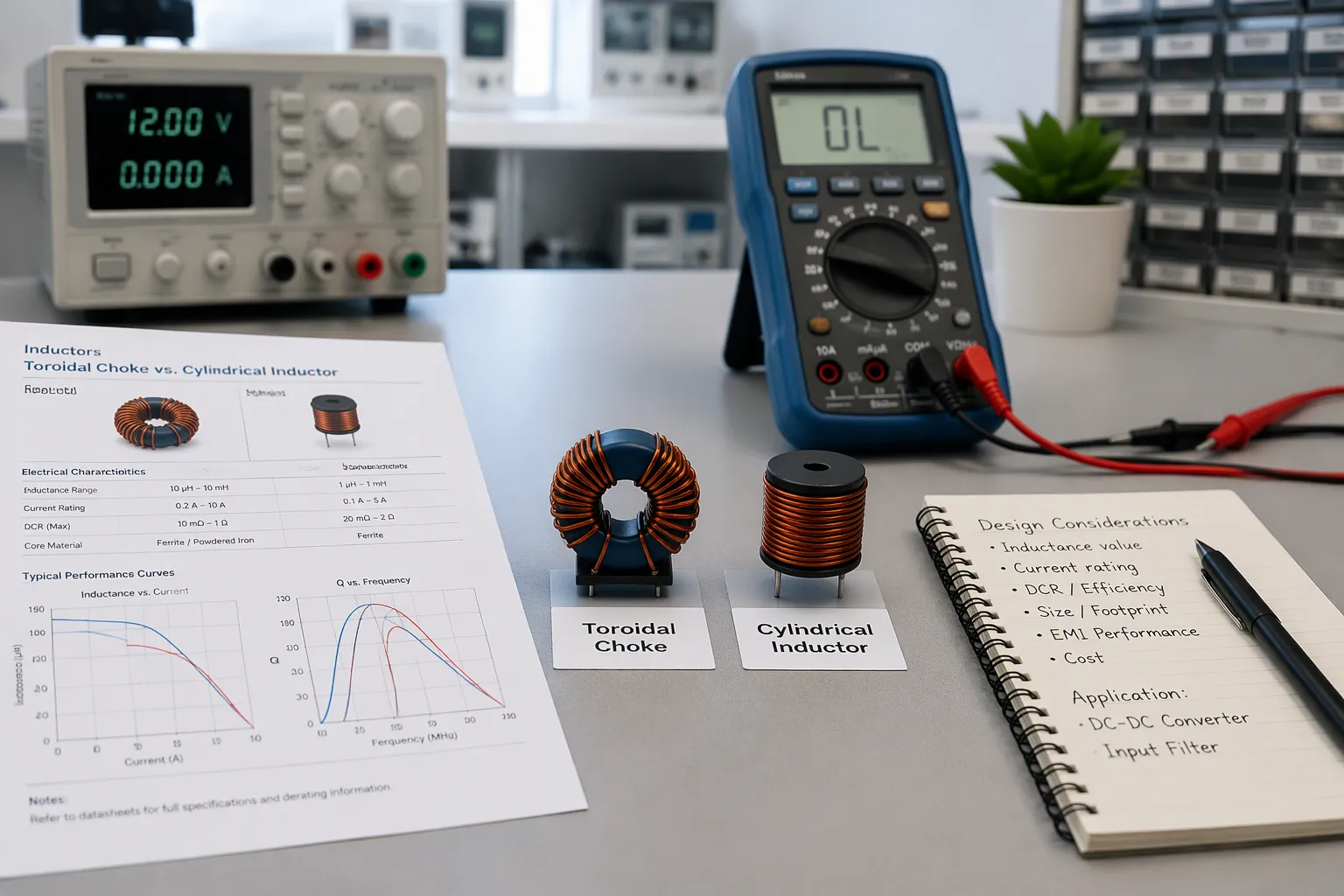
Technical Performance and Application Fit
Start with the job, not the label. Ask one question: what must this part do in the circuit? If it stores energy between switching cycles or shapes a signal band, you want a standard inductor. If it must pass DC or low-frequency AC while blocking high-frequency noise, you want a choke. That single question settles most of the choke vs. inductor debate before you open a datasheet.
Now check the numbers against that job. For an energy-storage inductor, look at inductance value, saturation current, and DC resistance. A part that saturates too early will drop out of regulation under load. For a filter choke, look at impedance at your noise frequency and stray capacitance. A choke with high capacitance loses its blocking power up the band. Winding style and core material drive both traits, so read those rows closely.
Think about the whole system too. A power supply may need a storage inductor in the converter stage and a filter choke on the input line. Common-mode chokes often join them to catch noise shared across both lines. Each part earns its spot by doing one job well. You don't swap one for the other, and you don't force a single part to cover two roles.
Compliance and Cost Considerations
Your target market sets the compliance bar. CE marking matters for products sold in Europe. RoHS restricts certain substances, and UL listing often comes up for safety-critical gear. Automotive programs usually expect IATF16949 from the supplier. Confirm these before you lock a part into the design, because a missing certificate can stall a whole build.
Cost deserves a fair look as well. Compare unit price, but also weigh failure risk, lead time, and testing effort. A part that meets every spec but arrives late can cost more than its price tag suggests. Balance performance, paperwork, and price together.
Suppliers who hold several certifications at once can simplify this step. Changzhou Southern Electronic Element Factory Co., Ltd., for example, offers inductors, common mode chokes, transformers, and resistors, and holds CE, ISO9001, ISO14001, IATF16949, UL, RoHS, and CQC certifications. That range lets you source related parts from one partner. Check each certificate against your own program requirements, then decide.
Neither part wins by default here. A standard inductor fits energy storage and signal work best. A choke fits noise blocking and DC pass-through best. Match the part to the job, confirm the compliance paperwork, and weigh the total cost. That approach keeps your design sound and your build on schedule.
Here's the takeaway: a choke is a specialized inductor. The choke vs. inductor choice comes down to the job the part must do. Need energy storage or signal shaping? Pick a standard part built for that work. Need to block high-frequency noise while DC passes through? A choke fits that role.
Don't treat the terms as interchangeable. Match the specs to your application instead. Check inductance, impedance at your noise frequency, and current rating against what the circuit demands.
Both parts have a clear place in good design. Pick each one for the job it does best, and your build will hold up.
FAQ
Can you use an inductor as a choke?
Yes, in many cases. A choke is just an inductor picked for a blocking job. Check the impedance at your noise frequency and the stray capacitance. A part built for energy storage may not block noise well up the band. Match the specs to the filtering role first.
Is a common mode choke still an inductor?
Absolutely. It uses two windings on one ferrite core, but the physics stays the same. It stores energy in a magnetic field like any inductor. You just choose it to catch noise shared across both lines. The blocking job defines the label, not a different device family.
Which one do you need for a DC-DC converter?
Go with a standard inductor. A converter needs a part that stores energy between switching cycles and releases it to the output. Look at inductance value, saturation current, and DC resistance. A filter choke is not built for that storage role.
Do chokes and inductors carry the same certifications?
The certification applies to the part and the supplier, not the label. CE, RoHS, UL, and IATF16949 requirements depend on your market and program. Confirm the paperwork for whichever part you select. A choke and an inductor from the same supplier often share the same compliance status.
Can one part do both jobs?
Rarely well. A part tuned for energy storage may block noise poorly, and a filter choke may saturate under heavy load. Most designs use each where it fits best. A power supply often needs a storage inductor in the converter and a choke on the input line.

