


Custom Toroidal Inductor Design: Fast Prototyping Wins OEM Contracts
 Oct 21, 2026|
 View:60
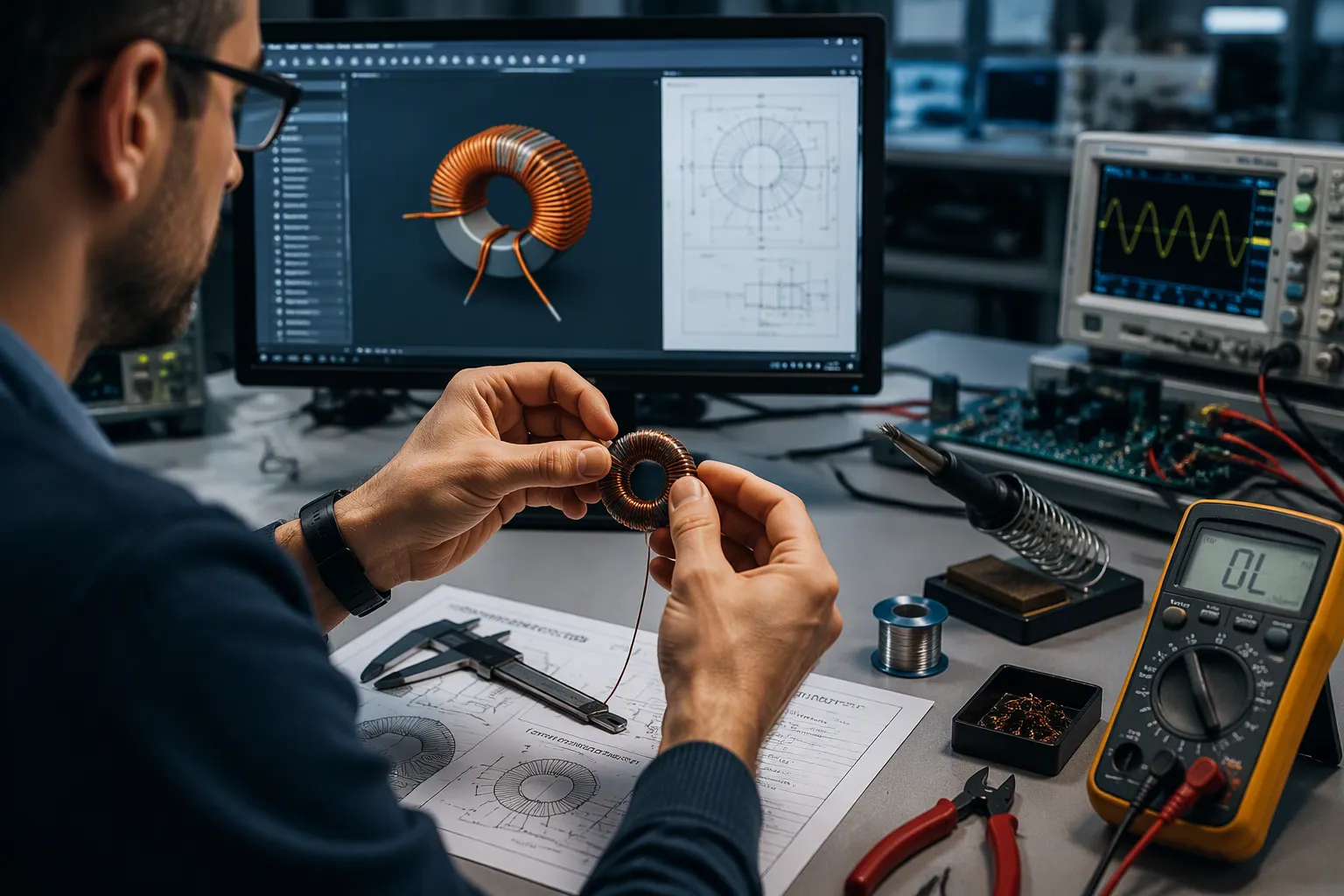
Custom Toroidal Inductor Design: How Fast Prototyping Wins Long-Term OEM Supply Contracts. Prototyping speed decides who wins long-term OEM supply contracts in custom toroidal inductor design. How fast prototyping wins long-term OEM supply contracts often comes down to how quickly a magnetics partner turns a specification into a working sample. OEM buyers weigh prototyping responsiveness heavily during supplier selection. Buyers typically require rapid prototyping followed by repeatable high-volume production. So a fast first article signals both engineering depth and scalable consistency. Early design involvement also raises switching costs, because changing an approved part triggers requalification. Suppliers who deliver responsive samples and clear validation data embed themselves in the program and earn renewal.
Key Takeaways
Speed is important: OEM buyers pick magnetic part suppliers who give fast prototypes and steady production.
Slow prototyping can cause delays, higher costs, and lost contracts. Fast samples keep launch dates on track.
Quick changes and ring-shaped cores lower costs and EMI, which leads to small and efficient designs.
A clear workflow from spec to tested sample in weeks helps win long-term supply contracts.
Judge partners by their design skills, testing ability, and certifications such as AEC-Q200 for automotive programs.
Custom Toroidal Inductor Design: Why Speed Wins Contracts
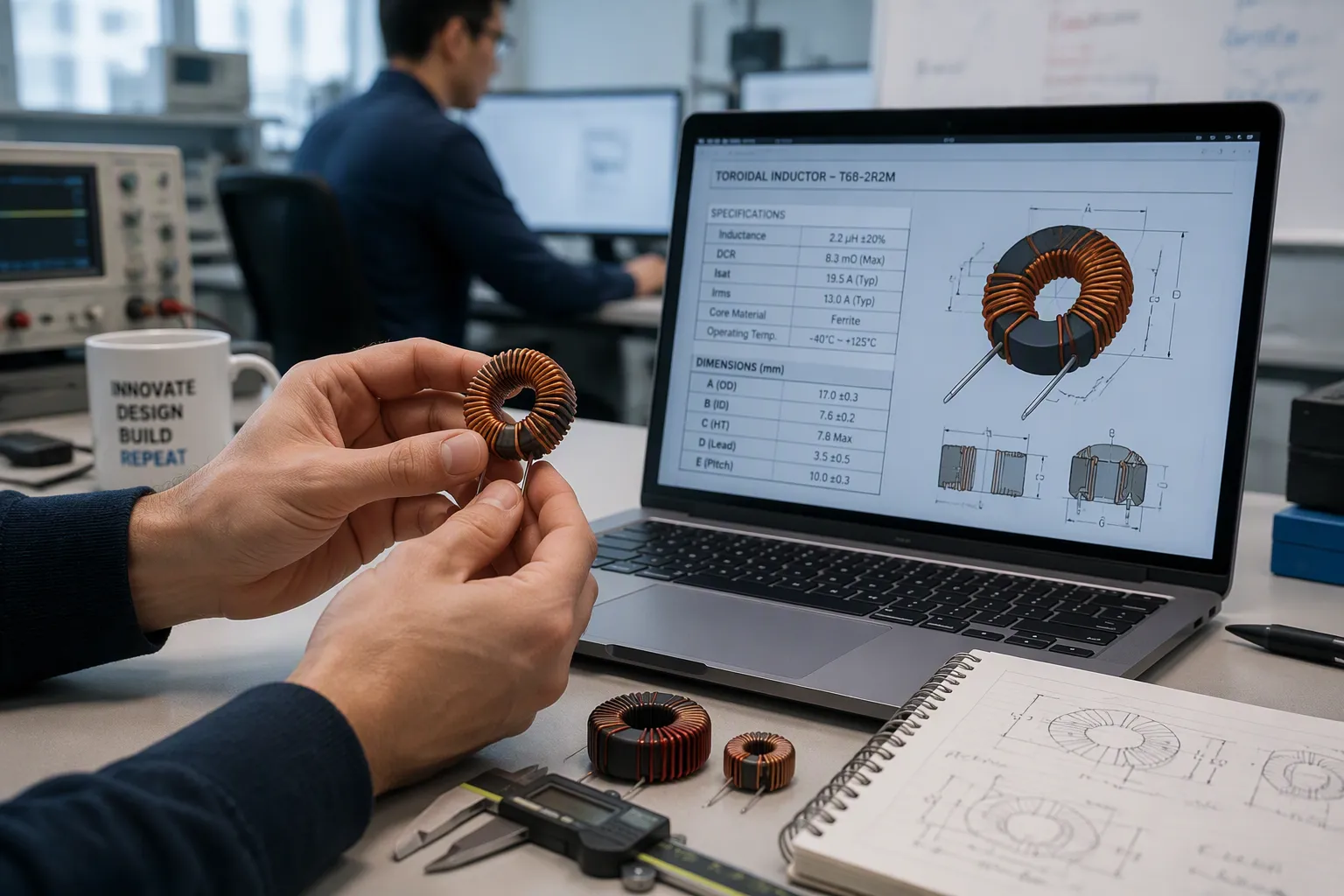
Speed as a Supplier Selection Criterion
Buyers pick magnetics suppliers based on how fast and reliable they are, not just on price. A quick prototype shows both. It proves the supplier has deep engineering skills and a production line that can repeat the sample at high volume. Buyers also compare consistency, cost savings, delivery assurance, and certification compliance. Delivery assurance matters most in early talks. Efficient production and modern equipment shorten cycles and make rapid prototyping possible. So speed works as a fit test. It separates suppliers who can handle a full program from those who cannot. Buyers notice that signal. That signal carries weight.
Buyers often score candidates on a shortlist matrix. Responsiveness sits next to quality systems and test capability. A supplier who answers a specification request in days and ships a sample in weeks scores well. A supplier who needs months to quote loses points before pricing even comes up. This scoring explains why speed matters beyond the first order. It predicts how the supplier will handle engineering changes later in the program.
The market shows this pattern clearly. One supplier advertises custom designs in 48 hours and prototypes in two weeks or less. Another pairs ISO-driven processes with quick prototyping and strong technical responsiveness. A third keeps standard parts on distributor shelves to shorten early design cycles. Each model fits a different program stage. A catalog part may serve a breadboard build. A custom sample serves a platform that needs a specific inductance, current rating, and footprint. Buyers should plan a proper technical qualification cycle. Sample evaluation and specification review come before any volume commitment. That step turns prototyping speed into a measurable shortlist factor. This is the practical meaning of custom toroidal inductor design: how fast prototyping wins long-term oem supply contracts.
Risks of a Slow Prototyping Partner
A slow partner creates a chain of cost. Validation slips first. The buyer cannot test the part in the target platform, so EMC pre-compliance and thermal checks wait. Launch windows then move or close. A missed window can push a program into the next buying cycle. Re-sourcing risk follows. The buyer starts a second search, and the original supplier loses the design wins it might have held. The second search also burns engineering hours the program had already spent once. Each delay adds cost.
These risks compound in demanding applications. Automotive power systems need parts that meet AEC-Q200 and hold long-term reliability across temperature and vibration. High-current inductors for such platforms require early validation, not late samples. Automotive inductors also face tight EMI limits, so every delay in sample delivery delays the filter tuning that keeps EMI in check. A supplier who returns a first article in weeks keeps the program on schedule. A supplier who returns it in months forces the buyer to look elsewhere.
Speed is not a criticism of any design approach. It is a practical filter. Programs with fixed launch dates cannot absorb slow iterations. Buyers know this before they sign. They also know that high current inductors built for one platform often seed the next. A fast first article therefore protects more than one launch. It protects the relationship. A slow one puts both at risk.
Business and Technical Payoff of Fast Prototyping
Faster Iterations, Lower Cost
Fast prototyping makes every design loop shorter. A supplier can change turns, core material, and wire gauge in days instead of months. Each quick loop lets the OEM test the part in the real circuit sooner. Early testing catches thermal and EMI problems before they become a frozen design. The program then avoids the cost of a late redesign, a second sample round, and a delayed launch. Getting the part right the first time saves engineering hours and protects the launch date.
Experienced design groups use software to work out the best custom solutions. The software models inductance, saturation, and losses before anyone winds a sample. This makes iterations even shorter. The buyer gets a design that already meets the target, not a first guess. Fewer physical builds follow, and each build carries more confidence.
Compact, Low-EMI Toroidal Performance
The ring shape pays off in tight enclosures. The winding covers the full core circumference, so the magnetic field stays mostly self-contained. Stray flux, the main source of radiated EMI from power transformers, drops by up to 90% compared with E-I laminated designs. These parts are also 40–50% lighter and smaller at the same VA rating. These traits support compact, efficient OEM platforms.
Toroidal cores bring more gains:
Low EMI suits systems with sensitive electronics nearby, such as medical instruments and precision measurement devices.
Minimal flux leakage and durable performance fit high-current inductors in automotive power systems.
Lower core losses and low parasitic capacitance allow compact, high-frequency power modules.
The doughnut-shaped core supports low leakage flux and high power handling, which drives adoption in sectors where reliability and energy efficiency are critical.
A correctly wound toroid holds stable inductance under high-current duty. Buyers of high current inductors gain the same benefit. That consistency matters for automotive inductors that must meet AEC-Q200 and for any design where the margin is tight.
Toroidal Inductor Prototyping Workflow
Spec to First Article
The workflow begins when the buyer sends in the specification. The buyer shares inductance, current rating, footprint limits, operating temperature, and any safety or EMC targets. The supplier checks the data and points out gaps before quoting. A clear intake stops wasted sample builds later on.
Design calculation comes next. Engineers use software to model core material, turns, wire gauge, and saturation behavior. This step gives a candidate design that meets the target without guesswork. The supplier then builds the sample. Winding, core mounting, and any resin encapsulation are done in-house. Resin encapsulation shields the winding from vibration and moisture in harsh environments.
Turnaround anchors keep the program on schedule. Quotes usually arrive in about seven days. Prototypes ship in roughly 14–21 days. These windows support rapid prototyping for programs with fixed launch dates. A toroidal inductor custom design that follows this path gives the buyer a working part fast.
Testing and Design Freeze
Validation turns a sample into an approved part. Pre-compliance EMC testing lets engineers find emissions problems early. They can look into noise sources and improve the design before formal compliance testing, which is slower and costs more. Conducted emissions split into differential-mode noise and common-mode noise. Each type needs its own filtering approach. Filter selection should account for attenuation needs, disturbance frequency range, leakage current, installation space, phase count, and applicable safety requirements.
Safety standards matter too. EN61558 covers transformer and inductor safety for many power supply applications. The supplier should confirm the design meets the relevant standard before freeze. For automotive programs, automotive emi standards and AEC-Q200 add another layer. Automotive inductors must hold reliability across temperature and vibration. Automotive power systems demand this level of rigor.
Rigorous testing includes batch consistency checks. Buyers should ask for per-batch test data covering inductance, DCR, saturation current, and hi-pot results, plus lot traceability records. This data supports quality control and proves the part will repeat in volume. High-current inductors and high current inductors for industrial use gain from the same discipline. Once validation passes, the design freezes and production begins.
Custom High Current Toroidal Inductors: A Design Case
The OEM Design Challenge
Picture a typical example. An OEM is building a small power module for an industrial platform. The launch date is set, and the design team needs custom high current toroidal inductors that fit a tight footprint. The specification calls for a specific inductance, a high saturation current, and steady performance across a wide temperature range. The team also needs the part to pass EMI pre-compliance without a major redesign.
The OEM's current supplier quotes a long lead time for samples. That delay would push validation past the launch window. The design team needs a toroidal part fast, so it can test thermal behavior and EMI in the real circuit. The program cannot absorb a slow first article. The buyer starts looking for a partner who can move quickly.
From Sample to Supply Contract
A second supplier takes the specification and returns a quote in about a week. Engineers model the core, turns, and wire gauge in software before winding anything. The first samples ship in roughly two to three weeks. The OEM tests them early and finds the part meets the target inductance and current rating. Minor tuning follows, and the supplier delivers revised samples quickly.
Early validation lets the OEM confirm EMI performance and thermal margins before design freeze. The supplier provides batch test data and traceability records. The part meets AEC-Q200 requirements for the automotive-adjacent program, and the design freezes on schedule. The OEM awards a long-term supply contract to the fast partner. The case is just an example, yet the pattern is common. Rapid samples reduce risk, and reduced risk wins the award.
Evaluating a Prototyping Partner for High-Current Inductors
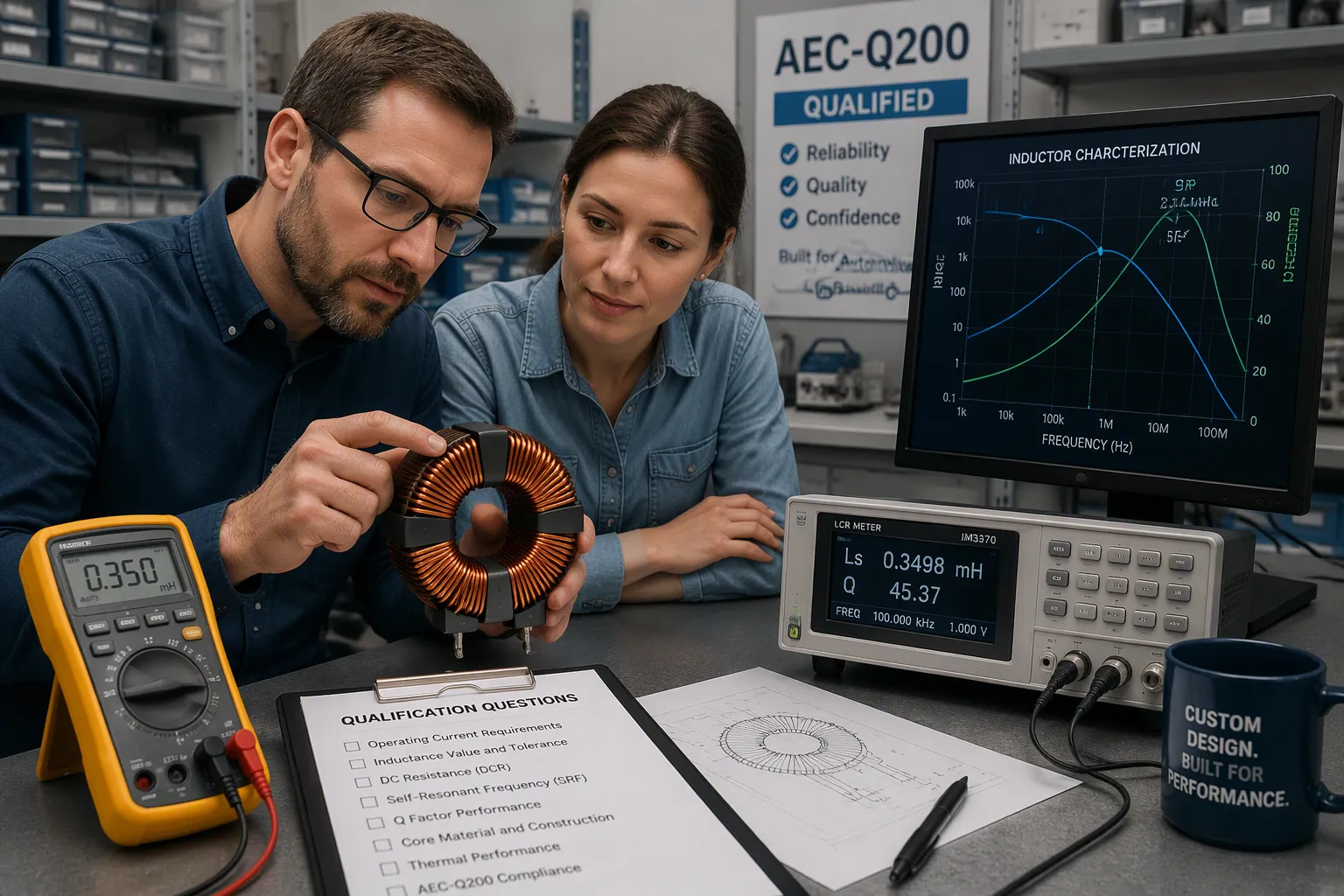
Qualification Questions to Ask
Buyers should check how deep a partner's skills go before giving them a program. Four questions help tell a supplier that is ready for a contract apart from a plain parts seller:
Does the partner offer prototype evaluation and early design review, and not just catalog supply?
Can the partner show real custom design skills instead of only catalog offerings?
Is there a clear path from prototype to production, with inventory programs and manufacturing coordination?
Has the partner worked with tough conditions like shock, vibration, and high heat?
In-house test capability matters next. The partner must measure self-resonant frequency, Q factor, and saturation current rating across the full operating temperature range with real equipment. A partner who cannot explain its core material choice for the application is a warning sign. Core material drives permeability, saturation behavior, and frequency response. Winding skills count too. Poor handling of skin and proximity effects raises AC losses and cuts efficiency at high frequency. Buyers looking at high-current inductors should also confirm experience with Litz wire and special winding types. Co-designing inductors with OEMs through validation shows real commitment. The key role of derating also deserves a direct question.
AEC-Q200 and Certification Signals
AEC-Q200 certification is not a suggestion for automotive programs. It is a must. Off-the-shelf parts rarely fit automotive power systems, where extreme temperatures, tight spaces, high currents, and strict EMI rules apply. A partner must offer custom design and meet AEC-Q200 compliance. The standard follows a zero-defect approach and rejects PPM-based acceptance rules. It relies on process controls at the sub-ppm level. Buyers should confirm which grade the partner's automotive high current inductors meet.
Grade | Temperature Range | Typical Application |
|---|---|---|
Grade 0 | -55°C to +165°C | Extreme under-hood or LED-driver designs |
Grade 1 | -40°C to +125°C | Standard underhood environments |
Rigorous testing covers biased humidity, thermal shock, board flexure, and life testing at high temperatures. A reliable automotive inductor also needs IATF 16949, which builds on ISO 9001 with traceability and process control. ISO 9001 alone is only a starting point. UL and RoHS show market readiness. Note that IATF 16949 certifies the plant, while PPAP approves a specific part. Buyers should ask where anneal and final test happen. Changzhou Southern Electronic Element Factory Co., Ltd. is one fit among options, offering 30+ years of experience, one-stop supply, and certifications including ISO9001, IATF16949, UL, and RoHS. Its strict quality control processes support automotive-grade DC/DC inductors, OEM/ODM high current flat wire inductors, and high current inductor solutions built for long-term reliability.
Fast prototyping in custom toroidal inductor design: how fast prototyping wins long-term oem supply contracts comes down to one pattern. A supplier who turns a specification into a tested sample in weeks earns the program, and the program renews.
The payoff is clear. Quick iterations cut cost, toroidal cores keep EMI low, and early validation protects launch dates. The workflow stays simple: specification intake, software-driven design, sample build, then EMC and safety testing before design freeze.
Buyers of high-current inductors, high current inductors, and automotive inductors should test this speed directly. Request a quote or a sample build, then measure the supplier's real turnaround.
FAQ
How fast can a supplier deliver a custom toroidal sample?
Most quotes come back in about seven days. Prototypes ship in roughly 14–21 days. That window lets an OEM test the part early and keep the launch date on track. Speed here supports custom toroidal inductor design: how fast prototyping wins long-term oem supply contracts.
Which tests should a buyer request before design freeze?
Ask for EMC pre-compliance, EN61558 safety checks where they apply, and per-batch data on inductance, DCR, saturation current, and hi-pot results. Lot traceability records matter too. These steps catch emi problems early and protect the frozen design.
Do high-current inductors need AEC-Q200?
Only automotive programs require it. AEC-Q200 applies to automotive inductors and follows a zero-defect approach. Industrial high-current inductors usually follow ISO9001 and IATF16949 process control instead. Buyers should confirm the grade and the plant certification.
What signals a contract-ready magnetics partner?
Look for in-house design software, real test capability, and a clear path from sample to volume. Certifications such as ISO9001, IATF16949, UL, and RoHS help. A partner who works with you through validation shows commitment. That pattern drives custom toroidal inductor design: how fast prototyping wins long-term oem supply contracts.
Can a fast sample partner also handle high volume?
Yes. A supplier who repeats the sample at volume proves both engineering depth and production consistency. Buyers should ask for batch test data and traceability records. Reliable high current inductors and high-current inductors come from that same discipline.

Recent News
1.Leading Toroidal Inductor Manufacturers in the USA
2025-12-222.Top 10 Toroidal Inductor Manufacturers Leading the Industry in 2026
2026-02-053.China Toroidal Inductor Manufacturer 2026: 13,000 m² Factory, 100M+ Annual Capacity
2026-09-214.Toroidal Inductor Distributor Program: Stock Models, Region Protection, and Reseller Margin
2026-10-145.Custom Toroidal Inductor Design: Fast Prototyping Wins OEM Contracts
2026-10-21

