


How to Select Automotive Grade Rod Inductors for EV Applications
 Jul 13, 2026|
 View:213
When you select automotive grade rod inductors for EVs, your choices significantly impact safety and overall performance. It is essential to consider critical electrical features, such as high current capability and DC resistance. Choosing the right inductor ensures stability and reliability in challenging automotive conditions. Rigorous quality checks and robust testing protocols are vital for maintaining system safety. The demand for automotive grade parts continues to grow as EVs require more power. The table below illustrates the importance of your selections. High saturation current inductors, commonly found in automotive grade components, exhibit much lower failure rates.
Inductor Type | Failure Rate | Temperature Rise |
|---|---|---|
Standard Inductors | 14.2% | 68°C |
High Saturation Current Inductors | 1.8% | 42°C |
Always select automotive grade rod inductors that comply with AEC-Q200 standards to ensure optimal reliability.
Key Takeaways
Pick automotive grade inductors that follow AEC-Q200 rules for safety and reliability in electric cars.
Look at important electrical features like inductance, saturation current, and DC resistance to make sure the inductor works well.
Choose inductors with low DC resistance so less energy is lost and your car’s systems work better.
Think about the core material; powdered iron works best for high-current uses, but ferrite is good for lower current needs.
Use a checklist to help you pick, making sure the inductor fits your design and meets all the needed performance requirements.
Select Automotive Grade Inductors: Key Parameters
When you pick inductors for electric vehicles, you need to look at some important electrical features. These features help you find the right power inductor for your car’s system. The table below lists the most common electrical features you should check for automotive-grade rod inductors in EVs.
Parameter | Definition | Importance |
|---|---|---|
Inductance (L) | Nominal inductance value at a specified frequency. | Determines energy storage and filtering capabilities. |
Saturation Current (Isat) | DC current at which inductance drops due to core saturation. | Critical for preventing circuit failure in power inductors. |
Temperature Rise Current (Irms) | DC current causing a specified temperature rise. | Ensures inductor can handle continuous load without overheating. |
DC Resistance (DCR) | Resistance of the copper winding causing power loss. | Low DCR is essential for efficiency and heat reduction. |
Self-Resonant Frequency (SRF) | Frequency at which the inductor behaves capacitively. | Important for maintaining inductive behavior in high-frequency circuits. |
Inductance and Tolerance
Inductance tells you how much energy the inductor can hold. It also shows how well it can block unwanted signals. You need to pick the right inductance for your circuit. If the value is too low, your circuit may not block noise well. If the value is too high, your circuit may react slowly. Tolerance tells you how much the real inductance can change from the rated number. A small tolerance means your system will work more as you expect. Always check both the inductance and tolerance when you choose inductors.
High Current Ratings
High current power inductors are very important in electric vehicles. These parts must carry a lot of current without getting too hot or losing their energy storage. You should check two main ratings: saturation current and temperature rise current. Saturation current shows the most current the inductor can take before it stops working right. Temperature rise current tells you how much current the inductor can handle before it gets too warm. High current density matters because EVs need small but strong circuits. When you pick high current power inductors, you help your car’s system use power safely and well.
Tip: Always check if your power inductor has AEC-Q200 certification. This standard makes sure the inductor can survive tough car conditions.
DC Resistance (DCR)
DC resistance, or DCR, measures how much the copper wire inside the inductor slows down the current. Lower DCR means less energy turns into heat. This makes your inductor work better and stay cooler. In cars, you want to lose as little power as possible. Here is why DCR is important:
Lower DCR means less energy is wasted.
Less power loss gives you better efficiency.
Better efficiency helps your circuits work well and last longer.
If you want your car’s system to work well, always pick inductors with low DCR.
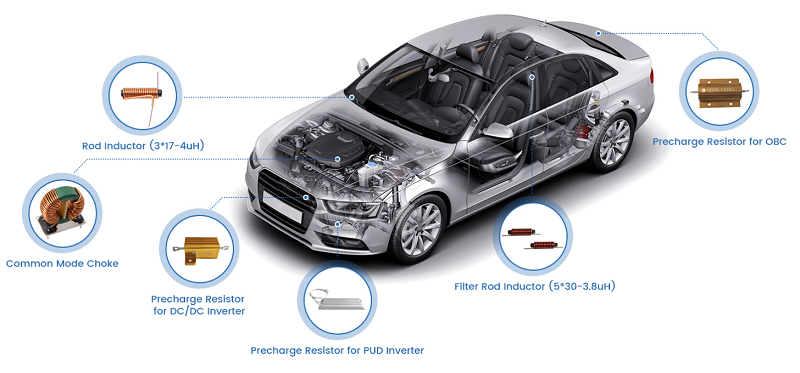
Self-Resonant Frequency (SRF)
Self-resonant frequency, or SRF, is the point where the inductor stops acting like an inductor and starts acting like a capacitor. You need to make sure the SRF of your inductor is higher than the highest frequency in your circuit. This keeps your circuit steady and makes sure the inductor works right. Good power inductors with high SRF help your car’s circuits work fast and well. Always check the SRF rating when you design high-frequency power systems for electric vehicles.
By knowing these key features, you can pick the best automotive-grade inductor for your EV. This helps you get good efficiency, strong performance, and reliable results in every car system you build.
AEC-Q200 and Reliability
Certification Requirements
When you pick inductors for cars, check for AEC-Q200. This standard helps make sure parts are safe and reliable in cars. If an inductor has this certification, it can handle the hard conditions inside electric vehicles. The table below shows the main things needed for automotive grade inductor certification:
Certification Requirement | Description |
|---|---|
AEC-Q200 Compliance | Mandatory for automotive-grade components. |
APQP (Advanced Product Quality Planning) | Ensures quality planning in production. |
Dedicated Production Lines | Specific lines for automotive-grade components. |
IATF 16949 Certification | Quality management standard for automotive. |
VDA 6.3 Process Audits | German automotive process audits. |
PPAP Submission (Level 3 offered) | Submission of production part approval. |
IMDS/CAMDS Material Reporting | Reporting for materials used in production. |
Critical Process Capability (CPK) ≥ 1.67 | Minimum capability index for processes. |
AEC-Q200 Testing | Validates reliability under various stress tests. |
Always pick power inductors that have AEC-Q200. These models are more reliable and last longer.
Vibration and Thermal Stability
Inductors in cars face many tough challenges. They must survive shaking, bumps, and big changes in temperature. Inductors with AEC-Q200 go through hard tests for strength and vibration. They are also tested for heat and protection from water or chemicals. These tests help you trust the inductor will not break on rough roads or in hot weather. Good thermal stability means the inductor keeps working when temperatures change fast.
Note: Reliable inductors must pass tough tests to show they are strong in heat and vibration.
Quality Control and Testing
You want your car’s parts to last a long time. That means every automotive inductor needs strong quality checks and testing. Makers use special tools and force control to test each inductor. These steps make sure the coil and core stay together, even under stress. Automated testing makes checking faster and saves money. Mass production uses these tests to keep quality high. Every inductor must meet IATF 16949 and pass all AEC-Q200 tests. This makes sure your car’s parts are safe and work well, even in hard conditions.
Aspect | Details |
|---|---|
Pressure Testing Tooling | Achieves breakthroughs in mass production for automotive customers. |
Force Control Design | Ensures stable application of over 2.5kg force, meeting reliability standards. |
Efficiency | Replaces manual operations, significantly enhancing inspection efficiency. |
Cost Optimization | Reduces testing costs by over 60%, accommodating mass production demands. |
Customer Verification Results | Coil and magnetic core detachment rate reduced to 0% after tooling testing. |
Mass Production Implementation | Tooling solution has become the standard testing process for this model of inductor. |
Technological Breakthrough | Resolved the contradiction of "small size + high reliability" in micro inductors. |
Compliance | Adheres to automotive-grade quality standards, including IATF 16949 certification. |
Always look for AEC-Q200 and IATF 16949 when picking inductors. These show the inductor passed all the right tests for car use.
Inductor Core Materials
Ferrite vs. Powdered Iron
It is important to know how the core material changes rod inductor performance in electric vehicles. The two main materials are ferrite and powdered iron. Each one works differently in your car’s circuits.
Powdered iron cores use a special mix that lets them handle more DC current before they reach saturation. This means they keep their inductance steady even when the load is heavy. Powdered iron also stays stable in hot or cold weather. Ferrite cores are made from another material. Ferrite reaches saturation quickly, so inductance drops a lot if the current gets too high. When it gets hotter, ferrite loses its ability to hold magnetic flux. This makes ferrite less dependable for high-current electric vehicle circuits.
Here is a table that compares these two materials:
Feature | Powdered Iron Cores | Ferrite Cores |
|---|---|---|
Current Handling | Handles more DC current before saturation | Saturates quickly with a big drop in inductance |
Thermal Stability | Stays stable in many temperatures | Loses flux ability as it gets hotter |
Inductance Stability | Keeps inductance steady under heavy loads | Inductance drops fast with high current |
Suitable Applications | Good for high-current DC-DC converters and cars | Works for general uses, not great for high current |
Note: Pick your core material based on how much current and heat your circuit will have.
Impact on Efficiency
The material you pick changes how efficient your electric vehicle system is. Powdered iron helps keep efficiency high because it holds inductance steady and does not get too hot. Your inductor works better with high currents if it does not lose performance. Ferrite works fine for regular uses, but it is not as efficient when the current is high. You need to match the material to your circuit to get the best efficiency.
Powdered iron helps powertrain and charging circuits work better.
Ferrite is good for circuits that do not need much current.
Always check the material’s properties to make sure your EV design is efficient.
Choosing the right core material makes your rod inductors work better and last longer. This helps your electric vehicle run well and stay reliable.
Application-Specific Inductor Selection
Picking the right inductors for each electric vehicle system helps your car work better. Every part of an EV, like the powertrain, charging system, ECUs, and ADAS, needs its own inductor design. You must choose an inductor that fits what each system needs. This keeps your car safe and reliable.
Powertrain and Charging
You need to look at a few main things when picking inductors for powertrain and charging systems. These systems use lots of power and must work in tough places. Use this checklist to help you:
Know how you will use the power inductor in your design.
Check the tolerance level your inductor can handle while working.
Look at important specs: maximum temperature, ESR, DCR, Irms, Isat, power used, current ratings, and power losses.
Inductors in these systems must handle high current and keep power losses low. This helps your EV last longer and keeps the power system steady.
Noise Filtering in ECUs
ECUs need inductors that block noise and keep signals clean. You should pick inductors with low DCR and high self-resonant frequency. This stops unwanted signals and keeps your car’s systems working well. Good noise filtering makes your power circuits more efficient and protects sensitive electronics. Always check the inductor’s size and make sure it fits your ECU design.
Tip: Use inductors with stable core materials to keep performance steady when temperatures change.
ADAS and Control Units
Inductors for ADAS and control units must meet strict rules. These systems use high-frequency signals for radar and LiDAR. You need inductors that work well in very hot or cold places and can handle strong shaking. Tight inductance tolerance is important for accurate signal processing. Metal powder core inductors help keep efficiency high and stop circuit failures. They also cut core losses at high frequencies, which is important for advanced car systems.
Factor | Description |
|---|---|
Inductance Value | Match the inductor’s inductance to your circuit’s needs. |
Current Rating | Pick an inductor that can handle the highest current without overheating. |
DC Resistance (DCR) | Choose low DCR to cut power loss. |
Saturation Current | Make sure the inductor can handle peak currents without saturating. |
Self-Resonant Frequency | Select a self-resonant frequency that fits your application. |
Tolerance | Use the right tolerance for reliable performance. |
Core Material | Pick the best core material for your automotive application. |
Size and Weight | Make sure the inductor fits your design’s space limits. |
Temperature and Voltage | Check ratings for temperature and voltage to ensure reliability in your automotive system. |
Choosing the right inductor for each EV system helps your car use power better, improves performance, and keeps your car safe.
Practical Checklist for Inductor Selection
Step-by-Step Process
You can use a checklist to help pick the right inductors for your car project. Follow these steps to get good results:
Figure out where you will use the inductor. Is it for powertrain, charging, ECUs, or ADAS in your car?
Write down what your circuit needs. List the inductance, current rating, and DC resistance.
Check the size and weight of the inductor. Make sure it fits your pcb and does not make your car too heavy.
Make sure the automotive inductor has AEC-Q200 certification. Only use automotive grade inductors that pass tough tests.
Look at the core material. Pick ferrite or powdered iron based on how much current and heat your circuit has.
Match the self-resonant frequency to your circuit. The SRF should be higher than your highest circuit frequency.
Test if the inductor works with your pcb. Make sure it can be mounted well and fits your pcb layout.
Compare tolerance and stability. Choose inductors with tight tolerance for steady work in your car.
Check how much heat the inductor makes at high current.
Tip: Always check again that your chosen inductors meet all your car and pcb needs before you finish your design.
Balancing Performance and Cost
When you pick a power inductor for cars, you need to think about both cost and quality. Do not pick an inductor just because it is cheap. Cheap parts might break when there is a lot of current or tough conditions. Instead, focus on these things:
Pick inductors from brands that are known for good quality. This helps you avoid problems in your car circuits.
Make sure the inductor matches your current and voltage needs. This keeps your pcb safe and avoids design problems.
Think about your car’s size and weight limits. Pick inductors that fit and do not add too much weight.
Look at your market and budget. Sometimes you need to spend more to get the right performance for your car.
Always check if the inductor can handle high loads and hard conditions. This is very important for electric vehicles.
You get the best value when you match your needs with the right inductor. Do not give up quality just to save money. Good inductors help your car’s pcb last longer and work better when there is a lot of current.
You should pay attention to the most important things when picking rod inductors for electric vehicles. Always pick automotive grade parts that have AEC-Q200 certification. This shows the inductor can survive hard car conditions and helps stop problems. The table below explains why AEC-Q200 is important for automotive rod inductors:
Aspect | Description |
|---|---|
Certification Importance | AEC-Q200 is very important for car parts. It makes sure they are safe, reliable, and high-quality. |
Testing Procedures | The tests include heating and cooling, shaking, and vibration. These check if the part is strong and works well. |
Impact on Failures | Following the rules helps stop failures that could cause expensive recalls or safety problems. |
OEM Consideration | Car makers look for AEC-Q200 when buying parts to meet tough rules. |
You also need to check if the inductor can handle high current and fits your car’s needs. Use this checklist to help you choose well:
Find out the Operating Frequency
Figure out the Inductance you need
Check the Current Ratings and use derating
Make sure the Package fits your PCB design
Look at Environmental and Regulatory rules
Make sure the Supplier has a good Quality System
If you follow these steps, you can pick the right automotive rod inductor for your electric vehicle project and feel sure about your choice.
FAQ
What does AEC-Q200 mean for automotive inductors?
AEC-Q200 means the inductor follows strict car rules. You can trust these parts in tough places. This certification helps stop problems in your electric vehicle.
How do you choose the right core material for automotive rod inductors?
You need to check how much current and heat your circuit needs. Powdered iron is best for high-current car circuits. Ferrite works well for lower current systems. Always pick the material that fits your car’s design.
Why is high current rating important in automotive EV circuits?
High current rating lets the inductor handle strong power. It keeps your circuits safe and efficient. This is very important because electric vehicles need reliable parts.
Can automotive rod inductors reduce noise in ECUs?
Yes. Automotive rod inductors help block unwanted signals. They keep ECUs stable and protect sensitive electronics. You get better signal quality and more reliable car systems.
What quality checks should you look for in automotive inductors?
You should check for AEC-Q200 certification and IATF 16949 compliance. These checks show the inductors passed tough tests. You get reliable parts for your electric vehicle projects.


