


 Sep 08, 2025
 View:3900
A High Frequency Transformer lets you convert alternating voltage, current, and impedance using high frequency alternating current (HFAC). You will find that it works at frequencies above 10 kHz, which means the transformer can be much smaller while still keeping isolation between circuits.
It helps transfer power efficiently from one frequency to another.
The global market size reached $2.7 billion in 2024 and continues to grow, showing how important this technology is for modern electronics and power systems.
Key Takeaways
High Frequency Transformers operate above 10 kHz, allowing for smaller and lighter designs while maintaining circuit isolation.
These transformers are essential in applications like power supplies, chargers, and industrial systems, providing efficient energy transfer.
Choosing the right core material, such as ferrite, enhances performance by reducing energy loss and improving efficiency.
Using advanced winding techniques, like Litz wire, minimizes resistance and heat, leading to better transformer performance.
High Frequency Transformers improve device efficiency, reduce size, and enhance performance, making them crucial for modern electronics.
High Frequency Transformer Basics

Definition
A High Frequency Transformer helps you change alternating voltage, current, and impedance in electronic circuits. You use it when you need to work with high frequency alternating current, usually above 10 kHz. This type of transformer lets you transfer energy between circuits while keeping them electrically isolated. You often find these transformers in devices that need to handle signals or power at high speeds.
Tip: When you use a High Frequency Transformer, you can make your devices smaller and lighter because higher frequencies allow for compact designs.
Here is a table that shows the main functions of a High Frequency Transformer in electronic circuits:
| Function | Description |
|---|---|
| Radio Transmitters and Receivers | Lets you convert signal power, match impedance, and filter signals in communication equipment. |
| Modems | Changes high-frequency signals for transmission and helps send data accurately. |
| Radar Systems | Processes high-frequency pulses, making detection more accurate and stable. |
| Medical Imaging and Treatment | Converts high-frequency energy for imaging and treatment devices. |
| Industrial Heating Equipment | Changes mains frequency energy into high-frequency currents for fast and even heating. |
| Signal Amplification and Noise Reduction | Boosts signal strength and lowers noise, improving signal quality. |
| Power Isolation | Keeps input and output circuits separate, making systems safer and reducing interference. |
| Adaptation and Impedance Matching | Matches impedance for better energy transfer and fewer signal reflections. |
Key Differences
You will notice some clear differences between a High Frequency Transformer and a standard power transformer. The most important difference is the frequency range. High Frequency Transformers work at frequencies from 10 kHz up to 10 MHz or more. Standard power transformers usually work at 50 Hz or 60 Hz, which matches the power grid.
Here is a table that compares the frequency ranges:
| Transformer Type | Frequency Range |
|---|---|
| High Frequency Transformers | 10kHz - 10MHz and above |
| Standard Power Transformers | 50Hz - 60Hz (grid frequency) |
You can also see other differences in how these transformers are built and used:
| Feature | High Frequency Transformers | Conventional Transformers |
|---|---|---|
| Operating Frequency | Several kHz to several MHz | 50/60 Hz |
| Core Material | Ferrite or powdered iron | Laminated silicon steel |
| Size and Weight | 5-10 times smaller for the same power rating | Larger and heavier for the same power rating |
| Efficiency | 85-95% | 95-99% |
| Winding Techniques | Litz wire, sectional or interleaved techniques | Thick copper conductors, layered or helical |
| Thermal Management | Needs forced air cooling or heat sinks | Uses natural cooling with larger surface area |
| Applications | Switch-mode power supplies, RF circuits | Power distribution, audio frequency applications |
High Frequency Transformers use special core materials like ferrite or powdered iron. These materials work better at high frequencies.
You will find that these transformers are much smaller and lighter than conventional ones with the same power rating.
They often use special winding techniques, such as Litz wire, to reduce losses at high frequencies.
High Frequency Transformers need better cooling methods, like forced air or heat sinks, because they can heat up quickly.
Note: When you choose a transformer for your project, always check the frequency range and construction details to make sure it fits your needs.
Working Principle
Electromagnetic Induction
When you use a High Frequency Transformer, you rely on the principle of electromagnetic induction. This process lets you transfer energy from one circuit to another without direct electrical contact. Here is how it works:
You send alternating current (AC) through the primary coil.
This AC creates a changing magnetic field, or magnetic flux, inside the transformer’s core.
The changing magnetic flux passes through the core and links to the secondary coil.
The movement of this magnetic field induces a voltage in the secondary coil.
The amount of voltage you get depends on the ratio of turns between the primary and secondary coils.
The transformer adjusts voltage levels efficiently and keeps the circuits safely isolated. This is very important for safe energy transmission in electronic devices.
A High Frequency Transformer uses these steps at much higher speeds than a regular transformer. The alternating current changes direction thousands or even millions of times per second. This rapid change makes the magnetic field switch quickly, which allows the transformer to work with smaller cores and fewer turns of wire.
Role of Frequency
The frequency of the alternating current plays a big role in how your High Frequency Transformer works. When you increase the frequency, you can use fewer turns of wire in the coils. This reduces copper loss and makes the transformer smaller and lighter.
As the frequency goes up, you need fewer winding turns, so copper loss goes down.
At high frequencies, iron loss (from hysteresis and eddy currents) can increase, so you must choose core materials carefully.
High frequency designs often use ferrite cores, which have low hysteresis and high resistivity. This helps reduce eddy current losses, even when the frequency is high.
You also need to think about magnetization inductance. This is the property that tells you how much energy the transformer can store in its magnetic field. Magnetization inductance affects the impedance of the transformer and changes how it behaves at different frequencies. If the magnetizing inductance is too low, the transformer may not work well, especially at high frequencies. Core loss and leakage inductance also depend on magnetizing inductance, and these factors affect the overall efficiency.
When you design a High Frequency Transformer, you must balance copper loss, iron loss, and magnetization inductance. This helps you get the best performance and efficiency for your application.
The concept of volt-seconds per turn is also important. It tells you how much voltage you can apply to each turn of the winding for a given time without saturating the core. At higher frequencies, you can use fewer turns for the same volt-seconds, which lets you make the transformer smaller.
Low frequency transformers have lower eddy current losses and stray capacitances.
High frequency transformers benefit from reduced magnetizing current, so you can use fewer turns of thicker wire.
Copper losses are more important in low frequency transformers, but high frequency transformers are generally more efficient because of their design.
By understanding these principles, you can choose or design a High Frequency Transformer that fits your needs and works efficiently in your electronic projects.
Design Features
Core Materials
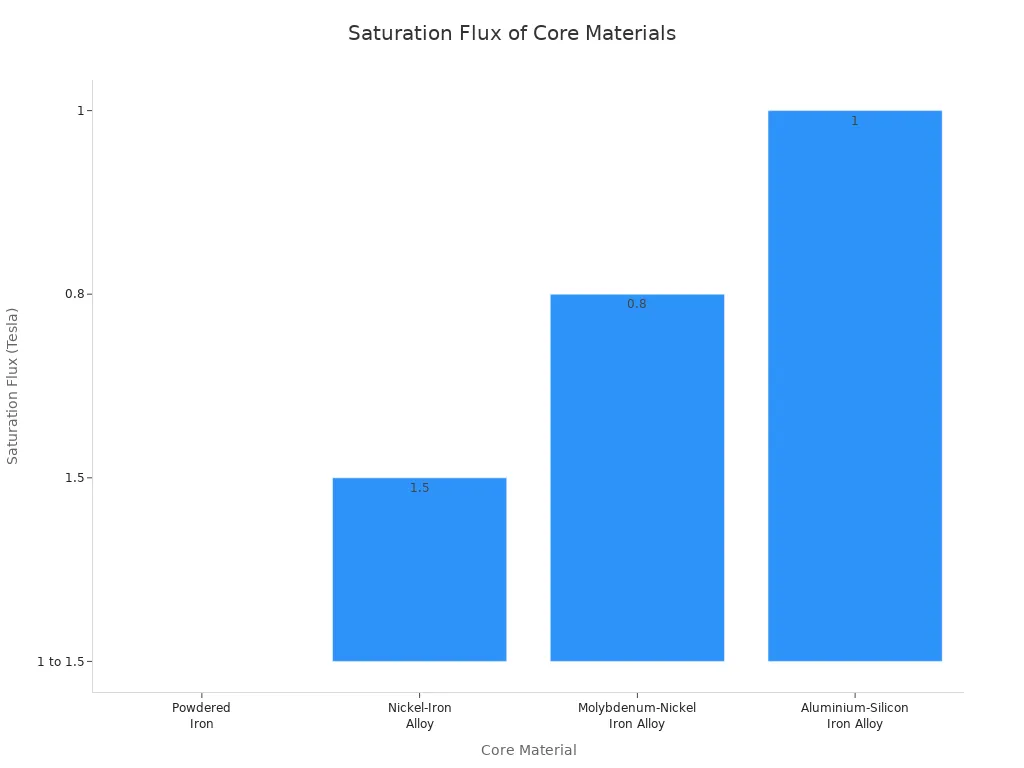
You need to choose the right core material to get the best performance from your High Frequency Transformer. Ferrite cores work well because they have low eddy current losses and high permeability. This means you can use them at high frequencies without losing much energy. Ferrite cores also come in many shapes, so you can design compact transformers. Other materials, like powdered iron and nickel-iron alloys, offer different magnetic properties. The table below shows common core materials and their features:
| Core Material | Saturation Flux (Tesla) | Permeability Characteristics | Applications |
|---|---|---|---|
| Powdered Iron | 1 to 1.5 | Higher core loss, limited to lower frequencies | Energy storage inductors, DC output chokes, differential mode chokes |
| Carbonyl Iron | N/A | High stability, excellent Q factors (50 kHz - 200 MHz) | High-frequency and broadband inductors and transformers |
| Hydrogen Reduced Iron | N/A | Higher permeability, lower Q than carbonyl iron | Electromagnetic interference filters, low-frequency chokes |
| Nickel-Iron Alloy | 1.5 | High energy storage, low residual flux density | High DC current bias applications, pulse and flyback transformers |
| Molybdenum-Nickel-Iron Alloy | 0.8 | Very low core loss, good temperature stability | High-Q filters, resonant circuits, transformers, chokes |
| Aluminium-Silicon-Iron Alloy | 1 | Very low magnetostriction, good temperature stability | Switching power supplies, pulse and flyback transformers |
| Nanocrystalline Alloy | N/A | Very good performance at lower frequencies | Chokes for inverters, high power applications |
Ferrite cores help you achieve high efficiency and compact size in high frequency designs.
Winding Methods
You can improve transformer efficiency and heat management by using the right winding techniques. Here are some common methods:
Layering and Interleaving: These methods reduce leakage inductance and parasitic capacitance, which helps energy transfer and lowers losses.
Foil Windings: Foil windings fight the skin effect and proximity effect, so current flows more evenly and heat spreads out better.
Litz Wire Windings: Litz wire uses many thin strands to reduce resistance at high frequencies, making your transformer more efficient.
Planar Transformers: Planar designs cut down stray capacitance and improve coupling, which means less energy is lost and heat is easier to manage.
Vacuum Pressure Impregnation (VPI): VPI boosts insulation and helps heat move away from the windings.
Winding Symmetry and Balancing: Balanced windings share the load evenly and keep efficiency high.
Try to match your winding method to your application for the best results.
Insulation
You must use strong insulation to keep your transformer safe and reliable. Insulation materials protect against electric shocks, overheating, and short circuits. Here are some materials you might use:
Paper: Offers high dielectric strength and resists heat.
Pressboard: Durable and reliable for keeping windings apart.
Oil: Cools and insulates, helping your transformer handle high temperatures.
Mica: Provides excellent electrical insulation.
Ceramics: Strong and stable, even when hot.
Polymers: Chosen for special needs, like flexibility or extra strength.
The right insulation keeps your transformer working safely, even in tough conditions.
Applications

High Frequency Transformers play a key role in many modern electronic systems. You will find them in devices that need efficient power conversion, compact size, and reliable performance. Here are some of the most common applications:
Power Supplies
You often see high frequency transformers in switch-mode power supplies (SMPS). These power supplies help you convert voltage efficiently, which is important for many electronic devices. You can find them in:
Medical devices
Communication devices
Commercial power supplies
Security systems
Support supplies for PLCs (Programmable Logic Controllers)
Audiovisual products
Switch-mode power supplies use high frequency transformers because they make the devices smaller and lighter. You get better energy efficiency, which helps your devices last longer and use less electricity. These transformers also provide electrical isolation, which keeps your devices safe.
High frequency transformers are essential in SMPS for their ability to efficiently convert voltage, which is crucial for the operation of laptops, smartphones, and LED drivers.
Chargers
You use high frequency transformers in cellphone chargers to achieve both compact size and high efficiency. Manufacturers choose ferrite cores for their high magnetic permeability and low losses at high frequencies. They use precise winding configurations, such as Litz wire, to reduce energy loss and improve performance. Good thermal management, like heat sinks and optimized PCB layouts, keeps chargers reliable and cool. Planar transformers with flat windings are becoming popular because they save space and handle heat well.
Key features in modern chargers:
Ferrite core material for efficiency
Litz wire windings to minimize losses
Advanced thermal management
Planar designs for compactness
Industrial Systems
In industrial power systems, you rely on high frequency transformers for safe and efficient energy transfer. These transformers provide electrical isolation in half-bridge power conversion circuits. You can use them to step up or step down voltage levels, depending on what your equipment needs. They help you transfer energy efficiently, which is very important in factories and large machines.
Main roles in industrial systems:
Adjust voltage for different loads
Enable efficient energy transfer in large-scale systems
When you choose a transformer for your application, always consider the specific needs of your device or system.
Advantages
Efficiency
You get higher efficiency when you use a High Frequency Transformer in your electronic devices. These transformers convert energy with less loss, so your devices run cooler and use less power. You can see the difference in the table below:
| Feature | High-Frequency Transformers (SMPS) | Conventional Transformers |
|---|---|---|
| Energy Conversion Efficiency | High | Moderate |
| Design Flexibility | High | Low |
| Size | Compact | Bulky |
| Heat Dissipation | Low | High |
| Input Voltage Compatibility | Wide | Limited |
| Application Suitability | High-Power, Space-Constrained | General Use |
You notice that high frequency designs waste less energy as heat. This means you can use them in places where you need reliable and efficient power, like laptops and chargers.
Size
You can make your devices much smaller when you choose a High Frequency Transformer. These transformers work at higher frequencies, so they need less core material and fewer windings. Here are some reasons why size matters:
High frequency transformers are smaller than traditional transformers for the same power rating.
The magnetic energy stored is more or less linear in mass, so you get more power with a smaller core.
As frequency increases, you can handle the same power with less space.
You see this advantage in portable electronics, where every millimeter counts. New materials like ferrites and nanocrystalline alloys help shrink transformer size even more. You can achieve up to 50% reduction in volume while improving energy conversion.
Performance
You benefit from better performance when you use high frequency designs. These transformers respond quickly to changes in load and voltage. You get stable power, even when your device needs to switch on and off fast.
Our evaluation of MAGTOP’s high-frequency transformers underscores their significance in modern power management. With meticulous attention to performance metrics and a commitment to innovation, MAGTOP’s transformers empower industries, elevate efficiency, and shape the future of power solutions.
Performance metrics you should look for include:
Size and Weight Reduction
Increased Power Density
Enhanced Efficiency
Faster Dynamic Response
You also need to consider core losses, winding losses, and EMI (electromagnetic interference). Using advanced core materials like ferrite and amorphous alloys helps reduce losses and improve reliability. Good heat dissipation lets your transformer work in high temperatures without problems.
Tip: When you select a transformer, check its efficiency, size, and performance metrics to make sure it fits your needs.
You can understand a High Frequency Transformer by looking at its main features:
It changes AC voltage, current, and impedance using an iron core and windings.
It works in switching power supplies, creating high-frequency pulses for voltage changes.
Its design reduces losses by minimizing leakage inductance and capacitance.
You find different types based on their frequency range.
These transformers help you achieve:
Compact device design
Reliable performance in sensitive circuits
| Consideration | Description |
|---|---|
| Core Material | Ferrite cores fit many shapes for different uses. |
| Winding Techniques | Litz wire and foil layers lower energy loss. |
| Loss Minimization | Interleaved windings and core gaps cut down on eddy current losses. |
| Heat Dissipation | Cooling methods keep your transformer safe and efficient. |
When you select a transformer, always match its features to your project’s needs for the best results.
What makes a high frequency transformer different from a regular transformer?
You use a high frequency transformer for circuits that need fast switching. It works at frequencies above 10 kHz. You get smaller size, lighter weight, and better efficiency compared to regular transformers.
Can you use a high frequency transformer for low frequency applications?
You should not use a high frequency transformer for low frequency tasks. The core material and winding design fit high frequencies. Using it at low frequencies can cause overheating and poor performance.
Why do high frequency transformers use ferrite cores?
You see ferrite cores in high frequency transformers because ferrite handles fast magnetic changes well. It has low energy loss at high frequencies. This helps your transformer stay efficient and cool.
How do you keep a high frequency transformer safe?
You keep your transformer safe by using strong insulation, good cooling, and careful winding. Always check for proper spacing between windings. Use materials that resist heat and electrical stress.


