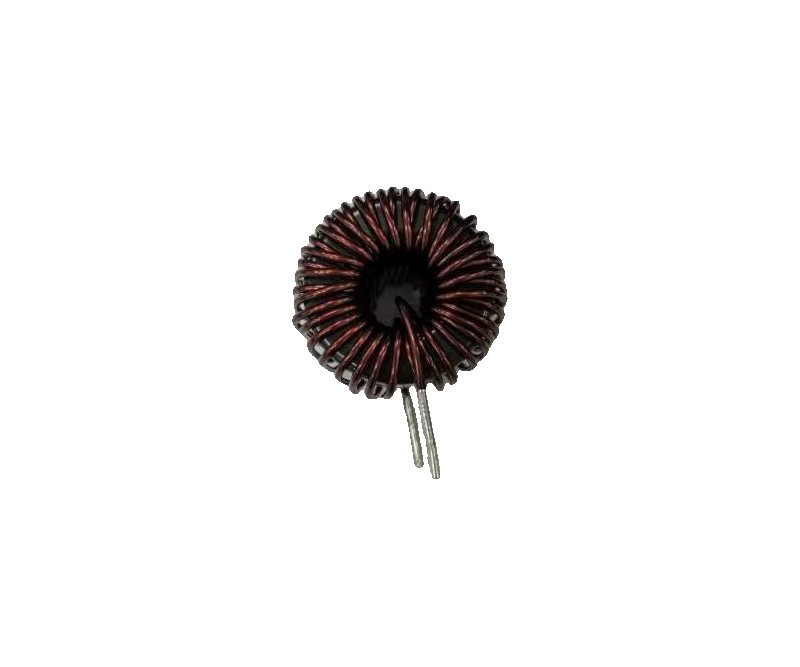
What is the difference between common mode and differential mode Inductor?
 Sep 22, 2025|
 View:2592
The distinction between Common Mode (CM) and Differential Mode (DM) inductors is fundamental to electromagnetic compatibility (EMC) and signal integrity. Understanding their differences is not just an academic exercise but a practical necessity for any engineer designing robust circuits.
This article will dissect the core differences between these two inductor types, exploring their construction, operating principles, functions, and applications.
Part 1: The Core Conceptual Difference – It’s All About the Current Path
The most fundamental difference lies in the nature of the electrical noise or signal they are designed to filter.
Differential Mode (Normal Mode): This refers to the intended, functional current that flows in a loop. In a typical two-wire system (e.g., VCC and GND), the current goes out on one line and returns on the other. The currents on the two lines are equal in magnitude but opposite in direction. This is the "good" signal you want to preserve.
Common Mode: This is an undesired, parasitic phenomenon. Common mode noise occurs when an unwanted signal (often from external RF interference, switching noise, or ground loops) appears on both conductors simultaneously and in phase. The currents on both lines are equal in magnitude and flow in the same direction. This noise creates an unwanted antenna effect, radiating electromagnetic interference (EMI).
An analogy: Imagine a two-lane highway.
Differential Mode is the normal traffic: cars (current) moving in opposite directions on their respective lanes.
Common Mode is an external shockwave that pushes all cars on both lanes in the same direction simultaneously—this is an abnormal and disruptive condition.

Part 2: Differential Mode Inductor (Choke)
A differential mode inductor is a standard inductor used to oppose changes in the differentialcurrent.
Construction: It is a simple inductor consisting of a single coil of wire wound around a magnetic core (e.g., iron powder, ferrite). It has two leads. They can be shielded (e.g., toroidal) or unshielded (e.g., drum core).
Operating Principle: It operates on the basic principle of inductance: it resists changes in the current flowing through it by storing energy in its magnetic field. Its impedance is given by , meaning its resistance to current flow increases with frequency.
Function and Use Case: Its primary role is to smooth current and filter high-frequency differential noise.
In Power Supplies: A DM inductor is a key component in buck, boost, and other switching regulator circuits, where it smooths the pulsating output current into a stable DC current. It works in tandem with a capacitor to form an LC low-pass filter.
In Signal Lines: It can be used to filter out high-frequency noise superimposed on a desired differential signal (e.g., in data lines like USB or Ethernet, though often more complex filters are used).
Key Characteristics:
High Saturation Current: It must handle the full DC load current without the core saturating, which would cause a drastic drop in inductance.
Low DC Resistance (DCR): To minimize power loss and voltage drop in the power path.
Self-Resonant Frequency (SRF): Operation is effective below this frequency.
Part 3: Common Mode Choke (CMC)
A Common Mode Choke is a specialized, coupled inductor designed specifically to suppress common modenoise while allowing the differential modesignal to pass through unimpeded.
Construction: This is where the key physical difference lies. A CMC consists of two identical windings wound on the same toroidal or E-shaped high-permeability ferrite core. The windings are bifilar (wound side-by-side) and symmetrical. The core material is chosen for its ability to absorb and dissipate common mode energy.
Operating Principle: This is the most critical concept to grasp. The core acts as a gateway that treats the two types of current completely differently.
For Differential Current (Desired Signal): The currents in the two windings are equal and opposite. According to Ampere's Law, their magnetic fields () inside the core cancel each other out. The result is a net zero magnetic flux. With no flux, the core does not get energized, and the inductor presents very low inductance (only the leakage inductance) to the differential signal. The desired signal passes through with minimal opposition.
For Common Mode Current (Noise): The currents are equal and in the same direction. Their magnetic fields add together inside the core, creating a high magnetic flux. The core now behaves like a large inductor, presenting a very high impedance () to the common mode noise. This high impedance blocks the noise, preventing it from propagating through the circuit or being radiated.
Function and Use Case: Its sole purpose is EMI suppression and ensuring EMC compliance.
Power Supply Inputs: The most common application is at the AC input of switch-mode power supplies (SMPS). It prevents high-frequency switching noise from the supply from traveling back onto the mains power line (conducted emissions) and prevents incoming mains-borne noise from entering the device.
Data and Communication Lines: Used on cables for USB, Ethernet, HDMI, etc., to prevent high-speed differential signals from radiating EMI and to protect the sensitive receivers from external common mode interference.
Ground Loop Noise Mitigation: Helps break ground loops by choking the common mode currents that flow through them.
Key Characteristics:
High Common Mode Impedance: The primary specification is its impedance at a specific frequency (e.g., "100Ω @ 100 MHz") for common mode signals.
Leakage Inductance: The small amount of residual inductance that is present for differential signals. This is an inherent parasitic property but can sometimes be leveraged as a cheap differential filter.
Rated Current: The maximum current it can handle without saturating from the differential current or overheating.
Voltage Isolation: It must be rated for the voltage between the line and ground.
Part 4: Comparative Summary Table
Feature | Common Mode Choke (CMC) | Differential Mode Inductor |
|---|---|---|
Primary Function | Suppress common mode noise (EMI filtering) | Smooth current, filter differential noise, energy storage |
Noise Type Targeted | Common Mode (in-phase noise on both lines) | Differential Mode (out-of-phase noise between lines) |
Construction | Two symmetrical, coupled windings on one core | One single winding on a core |
Number of Leads | 4 (two in, two out) | 2 |
Core Material | High-permeability ferrite (for high CM impedance) | Variety: ferrite, iron powder, Kool Mu® (chosen for saturation) |
Operation Principle | CM: Magnetic fields add, high impedance. | Simple inductance: opposes change in current () |
Key Parameter | Common Mode Impedance (e.g., Ω @ MHz) | Inductance (L), Saturation Current (Isat) |
DC Current Handling | Must handle full differential load current without saturating | Must handle full load current without saturating |
Typical Applications | AC mains filters, data line filters (USB, Ethernet), EMC compliance | Switching regulator power stages (buck/boost), LC filters |
Part 5: A Note on Leakage Inductance
An important parasitic property of a Common Mode Choke is its leakage inductance. Because the windings cannot be perfectly coupled, a small amount of magnetic flux does not link both coils. This uncoupled flux creates a series inductance that opposes the differentialcurrent. While often undesirable as it can attenuate the desired signal if too high, designers can sometimes utilize this leakage inductance as a cheap, built-in differential mode filter, reducing the need for a separate DM inductor in some applications.