


What is the difference between metal film resistor and carbon film resistor?
 May 26, 2025|
 View:2199
1. Composition and Manufacturing
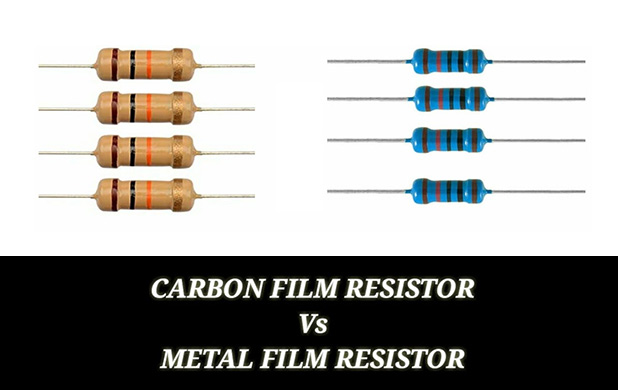
Constructed by depositing a thin layer of metal (e.g., nickel-chromium or tantalum nitride) onto a ceramic substrate via sputtering or vacuum deposition. The resistance value is adjusted by laser-trimming a helical groove into the metal layer, ensuring high precision (±0.1% to ±1% tolerance).
Example: DeMint’s MF series uses a nickel-chromium alloy for stability and low noise.
Made by coating a ceramic rod with a carbon-based film, often mixed with binders. The resistance is controlled by cutting a spiral pattern into the carbon layer. These are less precise (±5% tolerance) due to inherent material variability.
2. Electrical Characteristics
Precision and Stability:
Metal film resistors excel with tighter tolerances (±0.1%–1%) and low temperature coefficients (TCR: ±15–50 ppm/°C). Carbon film resistors typically have TCRs of ±200–500 ppm/°C, making them sensitive to temperature fluctuations.
Data: Metal film resistors maintain stability over 100,000 hours, while carbon film resistors may drift by ±5% over time.
Noise and Frequency Response:
Metal film resistors generate 10–100× less noise (Johnson noise < 0.2 µV/V) due to uniform metal grain structure. Carbon film resistors exhibit higher thermal noise (1–5 µV/V) from granular carbon particles.
High-frequency applications (e.g., RF circuits) prefer metal film resistors for their low parasitic inductance.
3. Thermal and Mechanical Properties
Power Handling:
Carbon film resistors tolerate higher surge currents (e.g., 15 kV pulses) due to carbon’s thermal stability. Metal film resistors are limited to ~500 V but dissipate heat more efficiently.
Operating Temperature:
Carbon film resistors withstand up to 350°C, suitable for power supplies and industrial equipment. Metal film resistors are rated for -55°C to 155°C.
4. Applications
Metal Film: Precision circuits (e.g., medical devices, audio amplifiers), ADCs, and low-noise analog systems.
Carbon Film: High-voltage/power systems (e.g., X-ray machines, laser drivers) where cost outweighs precision needs.
Metal film resistors dominate precision and stability-critical applications, while carbon films persist in high-voltage scenarios. Emerging materials like cermet films may bridge this gap.


