


What does a high frequency transformer do?
 Aug 11, 2025|
 View:3145
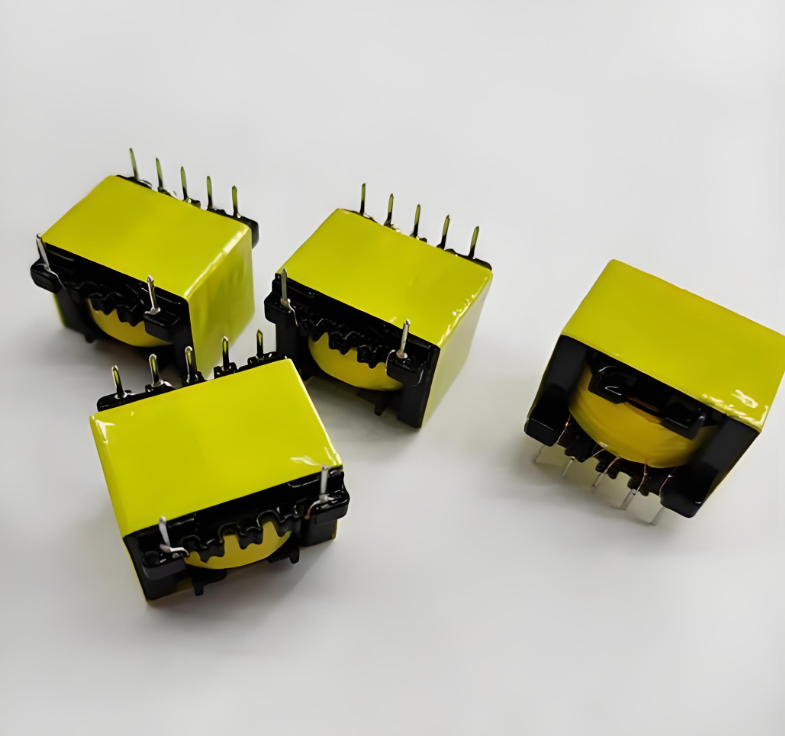
High frequency transformers are specialized electromagnetic devices designed to operate at frequencies significantly higher than conventional power transformers. While standard power transformers typically function at 50Hz or 60Hz (the standard utility frequencies), high-frequency transformers operate in the range of several kilohertz to megahertz. This fundamental difference in operating frequency gives high-frequency transformers unique characteristics and enables their use in specialized applications where size, efficiency, and power density are critical factors.
The primary function of a high-frequency transformer remains similar to its low-frequency counterparts: to transfer electrical energy between circuits while providing electrical isolation and voltage transformation. However, the higher operating frequency allows for substantial reductions in size and weight while maintaining or even improving power handling capabilities. This makes them indispensable components in modern power electronics, telecommunications, and various industrial applications.
Fundamental Operating Principles
At their core, High frequency transformers operate on the same basic electromagnetic principles as conventional transformers. They consist of primary and secondary windings wound around a magnetic core. When alternating current flows through the primary winding, it creates a time-varying magnetic field in the core, which induces a voltage in the secondary winding according to Faraday's law of electromagnetic induction.
The key difference lies in how frequency affects transformer design and performance. The voltage induced in a transformer winding is proportional to the rate of change of magnetic flux, which is directly related to frequency. This relationship is expressed by the equation:
V = 4.44 × f × N × B × A
Where:
V is the induced voltage
f is the frequency
N is the number of turns
B is the magnetic flux density
A is the cross-sectional area of the core
At higher frequencies, the same voltage can be achieved with fewer turns or a smaller core area, allowing for more compact designs. However, this advantage comes with several technical challenges that require careful engineering solutions.
Key Design Considerations
Designing High frequency transformers involves addressing several unique challenges that don't exist or are less critical in low-frequency transformers:
Core Material Selection: The magnetic core material must have low losses at high frequencies. Ferrite cores are commonly used because they offer high resistivity, reducing eddy current losses, and maintain good magnetic properties at high frequencies. Other materials like powdered iron or amorphous metal may be used depending on specific requirements.
Winding Techniques: Skin effect and proximity effect become significant at high frequencies, causing current to concentrate near the surface of conductors. This increases effective resistance and requires special winding techniques such as Litz wire (multiple individually insulated strands woven together) or flat copper foils to minimize losses.
Parasitic Elements: Stray capacitance and leakage inductance, which are often negligible at low frequencies, become critical at high frequencies. These parasitic elements can cause unwanted resonances, voltage spikes, and efficiency losses. Careful winding geometry and interleaving techniques are employed to control these effects.
Thermal Management: Higher operating frequencies generally lead to increased losses, requiring effective thermal management strategies. This may involve thermal vias in PCBs, special potting materials, or even forced air cooling in high-power applications.
Insulation Requirements: While the voltages might be lower than in power transformers, the high-frequency operation can stress insulation materials differently, requiring materials with good high-frequency dielectric properties.
Primary Functions and Applications
High-frequency transformers serve several critical functions across various industries:
Power Conversion and Conditioning: They are fundamental components in switch-mode power supplies (SMPS), DC-DC converters, and inverters. In these applications, they provide voltage transformation and isolation while allowing for efficient power conversion at high frequencies.
Impedance Matching: In radio frequency (RF) and telecommunications equipment, high-frequency transformers are used to match impedances between different circuit stages, maximizing power transfer and signal integrity.
Galvanic Isolation: They provide electrical isolation between circuits while allowing signal or power transfer, which is crucial for safety and noise immunity in many electronic systems.
Pulse Transformation: In pulsed power applications, such as radar systems or medical equipment, they are used to transform pulse characteristics while maintaining signal integrity.
Specific Application Areas
Switch-Mode Power Supplies (SMPS): The most widespread application of high-frequency transformers is in SMPS, which have largely replaced linear power supplies in most electronic devices. The higher operating frequency (typically 20kHz to several MHz) allows for smaller, lighter, and more efficient power conversion. SMPS are found in virtually all modern electronics from phone chargers to server power supplies.
Renewable Energy Systems: In solar inverters and wind power systems, high-frequency transformers are used in the power conversion stages to interface between the variable DC sources and the AC grid. They enable compact, efficient designs that can handle the wide input voltage ranges typical of renewable sources.
Electric Vehicle Charging: Both onboard chargers in electric vehicles and stationary charging stations use high-frequency transformers to provide the necessary voltage conversion and isolation. The high power density achievable with high-frequency operation is particularly valuable in automotive applications where size and weight are critical.
Telecommunications: RF transformers are used extensively in communication equipment for impedance matching, signal coupling, and isolation. They operate at frequencies from hundreds of kHz up to several GHz in some cases, enabling efficient signal transfer in transmitters, receivers, and networking equipment.
Medical Electronics: Medical equipment often requires strict isolation barriers for patient safety. High-frequency transformers provide this isolation in defibrillators, medical imaging equipment, and various monitoring devices while allowing for compact designs.
Industrial Electronics: Welding machines, induction heating systems, and plasma generators all rely on high-frequency transformers to deliver controlled power at high frequencies for specialized industrial processes.
Advantages Over Low-Frequency Transformers
The use of high-frequency transformers offers several significant advantages:
Size and Weight Reduction: Perhaps the most notable advantage is the dramatic reduction in physical size and weight. Because transformer size is inversely related to frequency, operating at higher frequencies allows for much more compact designs. A transformer operating at 100kHz can be 10-20 times smaller than a 50Hz transformer handling the same power.
Improved Power Density: The smaller size doesn't come at the expense of power handling. High-frequency transformers can achieve excellent power density, making them ideal for space-constrained applications.
Material Efficiency: Less core material and copper are required for the same power rating, reducing material costs and environmental impact.
Faster Response Time: The higher operating frequency enables faster response to load changes, which is crucial in many power electronic applications.
Reduced Low-Frequency Noise: The operation above the audible range eliminates the hum associated with low-frequency transformers.
Recent Technological Advancements
Ongoing research and development continue to push the boundaries of high-frequency transformer technology:
Advanced Core Materials: Development of new nanocrystalline and composite materials offers lower losses at higher frequencies and temperatures.
3D Printing of Windings: Additive manufacturing techniques are being explored to create optimized winding geometries that minimize parasitic effects.
Integrated Magnetics: Combining multiple magnetic components (transformers, inductors) into single structures reduces size and improves performance.
High-Temperature Designs: New insulation materials and techniques are enabling operation at higher temperatures, increasing power density.
GaN and SiC Compatibility: As wide-bandgap semiconductors (GaN, SiC) enable higher switching frequencies, transformer designs are evolving to take full advantage of these capabilities.
High frequency transformers play a vital role in modern electronics and power systems, enabling the compact, efficient power conversion that our technology-driven society depends on. From the charger that powers your smartphone to the inverters that connect renewable energy to the grid, these specialized components make possible the miniaturization and efficiency that characterize contemporary electronic design. As technology continues to advance, pushing operating frequencies higher and demanding greater performance from power electronic systems, the importance of high-frequency transformer technology will only grow. Their ability to provide efficient energy transfer, electrical isolation, and voltage transformation in compact packages ensures they will remain essential components in the electronic systems of the future.
As a leading one-stop electronic components solution provider, Established in 1989, presently Changzhou Southern Electronic Elements Factory Co.,Ltd has more than three hundred of staff and workers including more than sixty technicians who are engaged in various specialities. It covers an area about 13000 square meters with more than 8000 square meters of constr-uction area.
Our main products are: wirewound resistor, fusible wirewound resistor, membrane type fusible resistor, fixed inductor, filter, ferrite transformer, ring coil, special fuse for energy saving lamp and fuse with UL certificate, etc. Our annual production is now reaching: two hundred million pieces of resistors, two hundred million pieces of inductors, one hundred million pieces of transformers and coils and two hundred million pieces of fuses. These products are mainly used in household electric appliances, communication appliances, energy saving lamps, automatic control devices (e.g. transducers) electric power equipm-ents.and LED drive rower.Our products are exported to dozens of countries in Europe, America and Southeast Asia and used in many worldwide famous companies, such as GE, OSRAM, PHILIPS, etc.


Recommended Products

High Frequency Transformer (RM,POT TYPES)

High Frequency Transformer (PQ,EQ,LP Types)

Smt High Frequency Transformer (EFD Series)

High Frequency Transformer (EFD, EPC Types)

High Frequency Transformer (EE, EI, EF, EEL Types)

High Frequency Transformer (EER, ERL, ETD Types)

Smt High Frequency Transformer (EPC Series)


Recent News
1.What is the difference between low and high frequency transformer?
2018-09-302.What are high frequency transformers?
2024-11-083.What is high frequency transformer vs normal transformer?
2025-06-124.What is the range of a high frequency transformer?
2025-07-145.High Frequency Transformer: Working Principle and Design
2025-07-216.What does a high frequency transformer do?
2025-08-117.What is a High Frequency Transformer and How Does It Work
2025-09-08

